IAHRAG Webinar Series: Human Rights Council Complaint Procedure
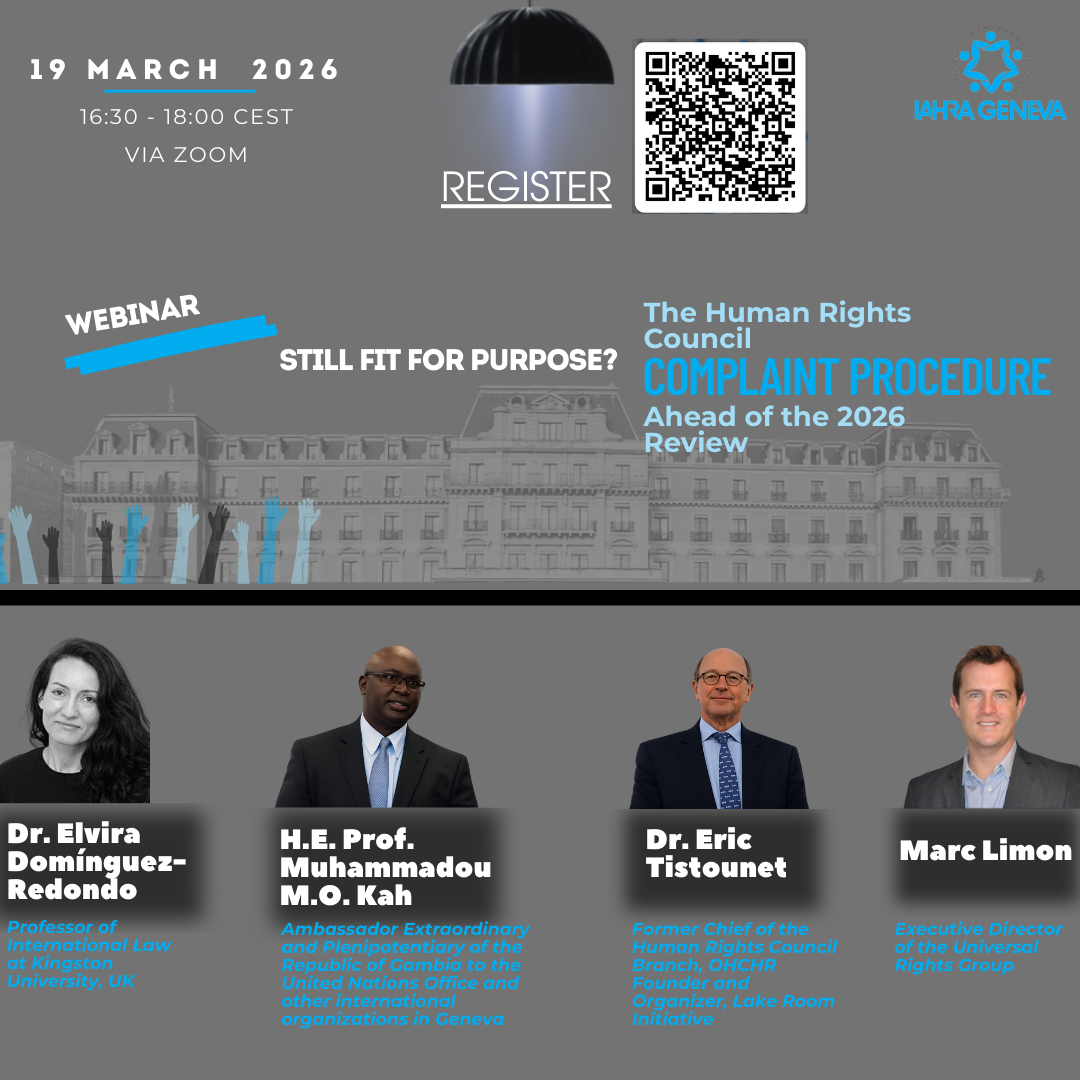
Still Fit for Purpose? The Human Rights Council Complaint Procedure Ahead of the 2026 Review
Register via the link below:
Concept Note
The Concern/Problem: The Human Rights Council (HRC) Complaint Procedure, established under Resolution 5/1 (18 June 2007), is a unique universal mechanism mandated to address consistent patterns of gross human rights violations without any jurisdictional hurdle. Built upon and reforming the former 1503 Procedure, it aims to ensure impartiality, objectivity, efficiency, victim-orientation, and timely handling of complaints.
Despite its significance, the procedure remains poorly understood and likely underutilized, a fact largely obscured by the confidentiality governing not only submissions but also subsequent proceedings of the Council, unless the Council decides otherwise, which is very rare in practice. Only two cases, the Kyrgyzstan case in 2006 (under the former 1503 procedure) and Eritrea in 2012, have been taken out of confidentiality, highlighting how exceptional public consideration is. This confidentiality has contributed to limited awareness or even interest among civil society, practitioners, and victims about key aspects of the mechanism and its value.
In addition, and again due to the confidentiality governing the Procedure, it is impossible to assess key aspects of the procedure, such as the admissibility criteria, the decision-making processes of both the Working Group on Communications and the Working Group on Situations, and the rare circumstances in which the Council may lift confidentiality or appoint an independent expert to monitor a situation. As the Procedure is not mandated to seek remedies in individual cases or provide compensation to alleged victims, the role of the individual complainant and the requirement of exhaustion of local remedies are often difficult to grasp, particularly since these complaints are generally representative of broader patterns rather than individual claims. There is also little clarity on how States actually cooperate with the Council, or how mechanisms intended to encourage such cooperation, such as requests for technical assistance, capacity-building, or advisory services, are used. In addition, there is limited understanding of what victim-orientation truly entails beyond requesting additional information from authors of communications. This lack of practical knowledge constrains the effective use of the Complaint Procedure and diminishes its potential as a powerful tool for victims and civil society to hold States accountable for systematic human rights violations.
In light of this, and given the upcoming UN General Assembly review of the Human Rights Council in 2026, which may examine the continued relevance and effectiveness of the Complaint Procedure, the proposed webinar aims to explore these issues in depth from multiple perspectives, including academic analysis, practitioner experience, victims’ insights, insider understanding of the procedure, and the perspective of States. The objective is not only to enhance understanding, but more importantly to assess whether this mechanism, in its current form, can still achieve its objectives and keep its value, in particular, in the face of prevailing attacks on international legal order.